
Browse Mount Olive City Directories
Mount Olive is best approached through the Morris County collections rather than a presumed township-by-township run. The county library identifies city directories for various communities and telephone directories from 1969. Its New Jersey Reference Collection holds more than 4,500 books, pamphlets, magazines, microfilms, manuscripts, maps, and atlases. Those materials can put a person, business, road, or village in a particular edition, but county and rural directories may be selective. A missing name can reflect the scope of the volume, not proof that the person was absent.
| Collection | Years | Where Held | Access |
|---|---|---|---|
| Vogt Bros. Complete Morris County Directory | 1897-98 | Morris County Library, microfilm reel 1 | Collection inventory and microfilm research |
| Richmond's Morris County Directory | 1902-03 and 1904-05 | Morris County Library, microfilm reel 3 | Collection inventory and microfilm research |
| Richmond's Morris County Directory | 1906-07 and 1908-09 | Morris County Library, microfilm reel 4 | Collection inventory and microfilm research |
| Morris County and Morristown directory holdings | Morris County 1897-1909; Morristown 1885-1982 | Morristown & Morris Township Library | Library research sources and reading-room holdings |
| Morris County telephone directories | From 1969 | Morris County Library | Library collection |
The listed years are confirmed collection coverage, not a promise of a Mount Olive line in every edition. The online catalogs did not provide a readable official image of a Mount Olive resident entry or a separate online finding aid for that purpose. Treat the reel, edition, and scope as the first citation, then inspect the actual volume before drawing a conclusion.
Mount Olive Directory Reels
The Vogt and Richmond titles make the turn of the twentieth century unusually concrete. Reel 1 carries the 1897-98 Vogt Bros. directory. Reel 3 carries the Richmond editions for 1902-03 and 1904-05, and reel 4 continues with 1906-07 and 1908-09. Morristown & Morris Township Library independently lists Morris County directories from 1897 through 1909. That agreement makes the library shelf a sound starting point for a Mount Olive family or place question in that period.
| March 22, 1871 | Mount Olive Township formed from Roxbury Township, creating a useful change in municipal search terms. |
|---|---|
| 1897-98 | Vogt Bros. Complete Morris County Directory is listed on Morris County microfilm reel 1. |
| 1902-09 | Richmond editions span reels 3 and 4, while another library list identifies Morris County coverage through 1909. |
| From 1969 | Morris County Library reports telephone directory holdings from this point onward. |
The Morris County Library directory holdings show the type of collection route behind those references.
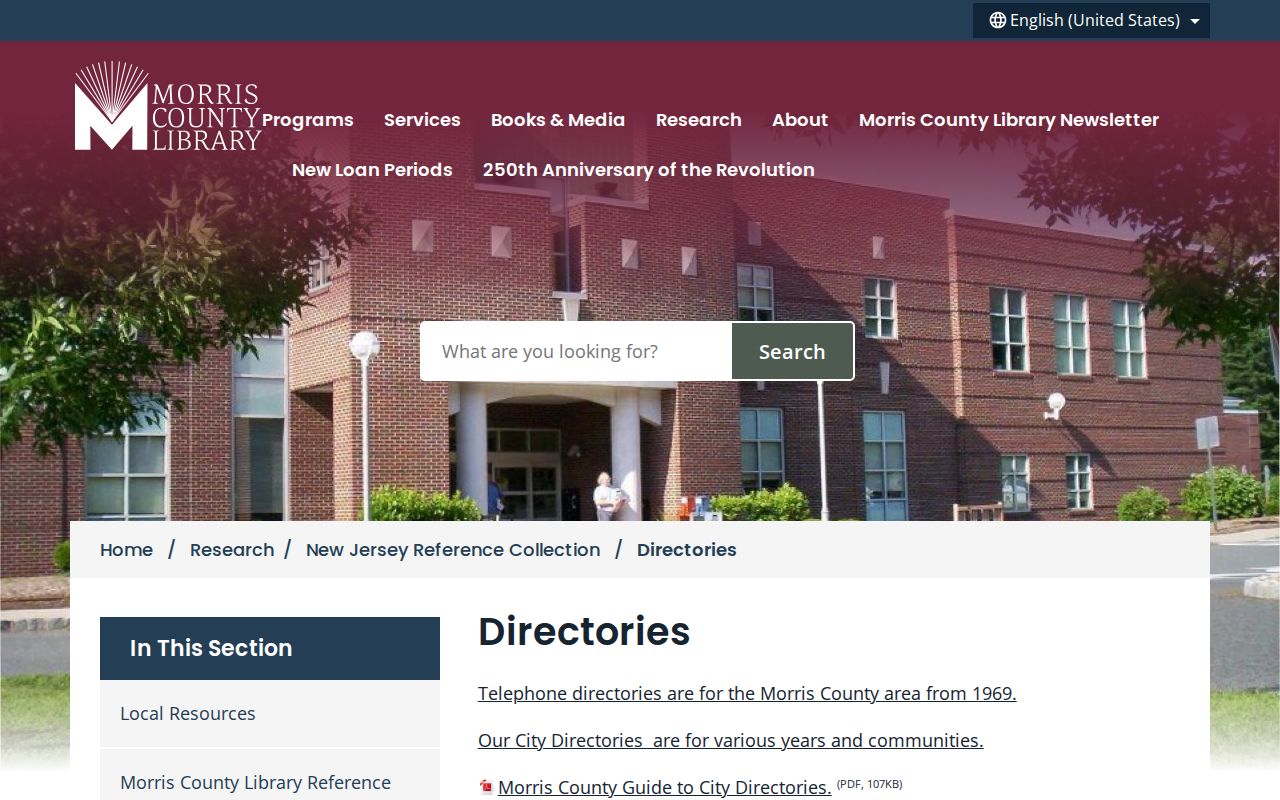
The catalog view supports collection-level research, not a claim that every listed title has been digitized or that every rural household appears. Note the edition and reel before transcribing names, community labels, or any printed address.
Insider tip. Record the title, date, reel, page, and whether the entry was viewed on microfilm or in print. A later researcher can then return to the same edition even if the catalog wording or online interface changes.
Reading Mount Olive Directory Entries
Because no readable official Mount Olive entry image was located, the responsible sample is an inventory of fields to capture after opening a volume. Do not fill in a name, address, or family relationship from expectation. The printed layout varies by publisher and year. Copy only the field that appears, preserve abbreviations, and keep the edition with the transcription. A county directory can also organize people by community or include institutions and businesses that are not household listings.
| Printed name | Copy the spelling, initials, and suffixes exactly as the volume prints them. |
|---|---|
| Address or community | Record a numbered address only when printed; otherwise preserve the village, road, or community label. |
| Occupation or business | Transcribe it only as an edition-specific clue, not as a claim about a present-day person. |
| Spouse or household note | Capture an annotation only when that particular volume includes one. |
| Institutional note | Keep a school, church, farm, or business annotation separate from a household conclusion. |
- Criss-cross directory
- An address-order section, when a directory includes one, that can be used to locate the printed names attached to a street or building sequence.
- Householder index
- A name-oriented index to the person or household the volume chooses to list. Its coverage follows that edition's rules.
- Abbreviation key
- The publisher's explanation of marks and shortened words. Photograph or copy it before interpreting a line.
Mount Olive Directory Access Myth
County coverage is not the same as complete Mount Olive coverage. The available titles are county-wide or centered on Morristown, and the research did not locate an official online scan that exposes a Mount Olive resident line. Printed directories can omit rural households, use a village label, or list a business or official without identifying a home. A telephone directory beginning in 1969 is another dated publication, not a retrospective record of every prior household.
Myth. A name search does not make a historical vital record open to anyone. New Jersey's genealogical access windows differ by record type: births over 80 years, marriages over 50 years, and deaths over 40 years. A directory line can provide a lead, but the Archives and record custodian control access to the underlying record.
Mount Olive Directory Search Names
Mount Olive Township began on March 22, 1871, from Roxbury Township. That date matters when the search runs before the township's creation. Try Roxbury, Morris County, Budd Lake, Flanders, Waterloo, Bartley, Drakestown, Smithtown, Mount Olive Village, a church, a post office, or a road or farm name as appropriate to the period. Historical sources can retain a narrower place term long after a modern search would group the area under Mount Olive.
Keep the source spelling alongside a normalized search note. “Mt. Olive,” “Mount Olive,” a Flanders postal label, and a village name can all be useful retrieval terms. Do not silently modernize the record. If a name appears only in a community list, label it as a historical directory clue with that edition's date rather than treating it as a current address.
Mount Olive Directory Archive Names
The New Jersey State Archives gives the directory trail a broader set of dated sources. It reports more than one million indexed records and provides online search, mail research, and Microfilm Room access. Its historical vital collections include births from 1848 through 1925 and marriages and deaths from 1848 through 1950, alongside selected censuses, deeds, divorce material, county-clerk marriages, and delayed or corrected birth records. Each index has its own coverage and access path.
For pre-1848 questions, births were generally not filed apart from certain slave-child records beginning in 1804. County-clerk marriage records begin in the 1795 period, while Chancery divorce material, special censuses, and county deeds supply different forms of evidence. The State Archives can establish a dated family or land lead, but it does not turn a directory reference into proof of a complete household or a current location.
Trace Mount Olive City Directories
A household trace works best when every result remains tied to its edition and record type. The early county reels can bridge gaps between the federal census years, but they should be paired with the census rather than treated as a substitute. This sequence keeps dates visible and avoids joining people who merely share a name.
- Start with the earliest confirmed name, village, or road reference and cite the specific directory edition.
- Check the next available county directory, recording every spelling, address or community field, and printed annotation.
- Compare the directory date with the surrounding federal census years, and then use the New Jersey state census schedule where its coverage helps.
- When an address appears, use the Mount Olive street address directory for the modern parcel and address-record sequence rather than assuming an old printed label still maps directly.
- Use newspapers, obituaries, deeds, cemetery material, and estate records to test whether an absence reflects a move, death, unlisted status, or a collection gap.
A disappearance from a printed directory has several possible explanations. A person may have moved, died, been omitted by the publisher, lived outside the volume's scope, or appeared under a different spelling. The best result preserves those alternatives until a second dated source resolves them.
Mount Olive Directory History Referrals
Mount Olive Public Library, at 202 Flanders-Drakestown Road in Flanders, offers a catalog, databases, and local referrals. Morris County Library adds county directories, maps, manuscripts, newspapers, oral histories, photographs, and genealogy resources. Its genealogy service can assist with obituary research for deceased Morris County residents when a name, date, and last residence are supplied. These are research access points, not public household lists.
The Mount Olive Historical Society has artifacts, exhibits, publications, and programs, with first-Monday meetings at the Senior Center except July and August. No public finding aid or resident directory was located for its holdings. Contact the society before assuming that an item is open, digitized, or indexed. The same care applies to library microfilm and archive materials.
Mount Olive Directory Records Before 1871
The 1871 formation date is a practical search switch. Before it, a person, farm, church, or land record associated with today's Mount Olive may appear under Roxbury or a smaller historic community. After it, a county directory may still favor a village, road, or post office over the new township name. Search both sides of the boundary rather than treating the municipal name as fixed through time.
Mount Olive's record history also moves between paper collections, microfilm, and newer portals. Preserve the collection title, access date, edition, page, and whether the evidence is an index, image, or staff-assisted reference. That small record of method is often what makes a historical directory lead usable later.
Older archival material has limits of its own. Morris County surrogate records are mostly not microfilmed, and an online record may present an index while restricting the document image. For early family work, record both what was found and what was not located, including the searched date range and place-name variants. That approach keeps a plausible lead from becoming a false household conclusion and gives the next library or archive visit a specific purpose.